Showing posts with label History. Show all posts

12/09/2011

  Even if Ebenezer Scrooge is getting a rude awakening or three on the stage of the Byham Theater this weekend during a run of "A Musical Christmas Carol," we're happy to say that we've not spotted ghosts of any sort at Market Square these days. Okay, maybe we do get a little spooked at the idea that there are only 16 shopping days left to wrap up our holiday shopping. But that's a story for another blog (hint, hint). Still, we thought we might take a short sleigh ride down memory lane to revisit some of Downtown's most-treasured remembrances of holiday traditions from seasons past.

Just so you know, we really searched around for some really old-time Christmas stories about Market Square.

One reason that we came up with nothing but a lump of coal is that early Americans didn't celebrate the occasion because they considered the custom to be "too English." In fact, the first Congress to serve under the newly ratified U.S. constitution stayed in session on Dec. 25, 1789.

Seriously, can you imagine that? Christmas started to turn a corner in America in the 1820s but it didn't become a big deal celebration until the mid-1800s.  A Victorian Christmas focused a lot on generosity and small family celebrations. Of course, some of our local forefathers probably managed to enjoy the spirit of the season by imbibing the spirits of the season right in our very own Market Square. In the late 1800s maybe even in the Oyster House!
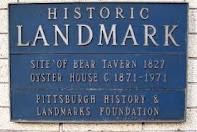
 
Most likely, these groggy old St. Nick's couldn't remember how they made merry on the morning after. Which is probably why we can't share any holiday tales on the Square.

But it's not our nature to "Bah, humbug" anyone. So let's put on our walking shoes to return to old haunts from holidays of a more recent vintage, when Downtown seemed to have more department store Santas than there are elves at the North Pole. Many of the stores even set up "special" shops where youngsters could buy inexpensive stocking stuffers for Mom and Dad after telling the big guy what big surprises they hoped to see under the tree.

Speaking of stores, everyone lined up back then to "oooo" and "ahhh" at the holiday window displays at Horne's and Gimbel's and Kaufmann's. From Thanksgiving evening to New Year's Day, the fabulous holiday scenes captured the imaginations of everyone from the tiniest tots to the tops execs of the city's Fortune 500 corporations.


Pittsburghers tuned their radios to 1020 AM during the holidays as KDKA DJ Jack Bogut spun his homey tales across the airwaves and raised money for the Children's Hospital Free Care fund as he broadcast from store windows while passersby pitched in for a great cause.


Trees have been a big deal for Downtown also. Check out this beauty at the City-County Building in 1933.
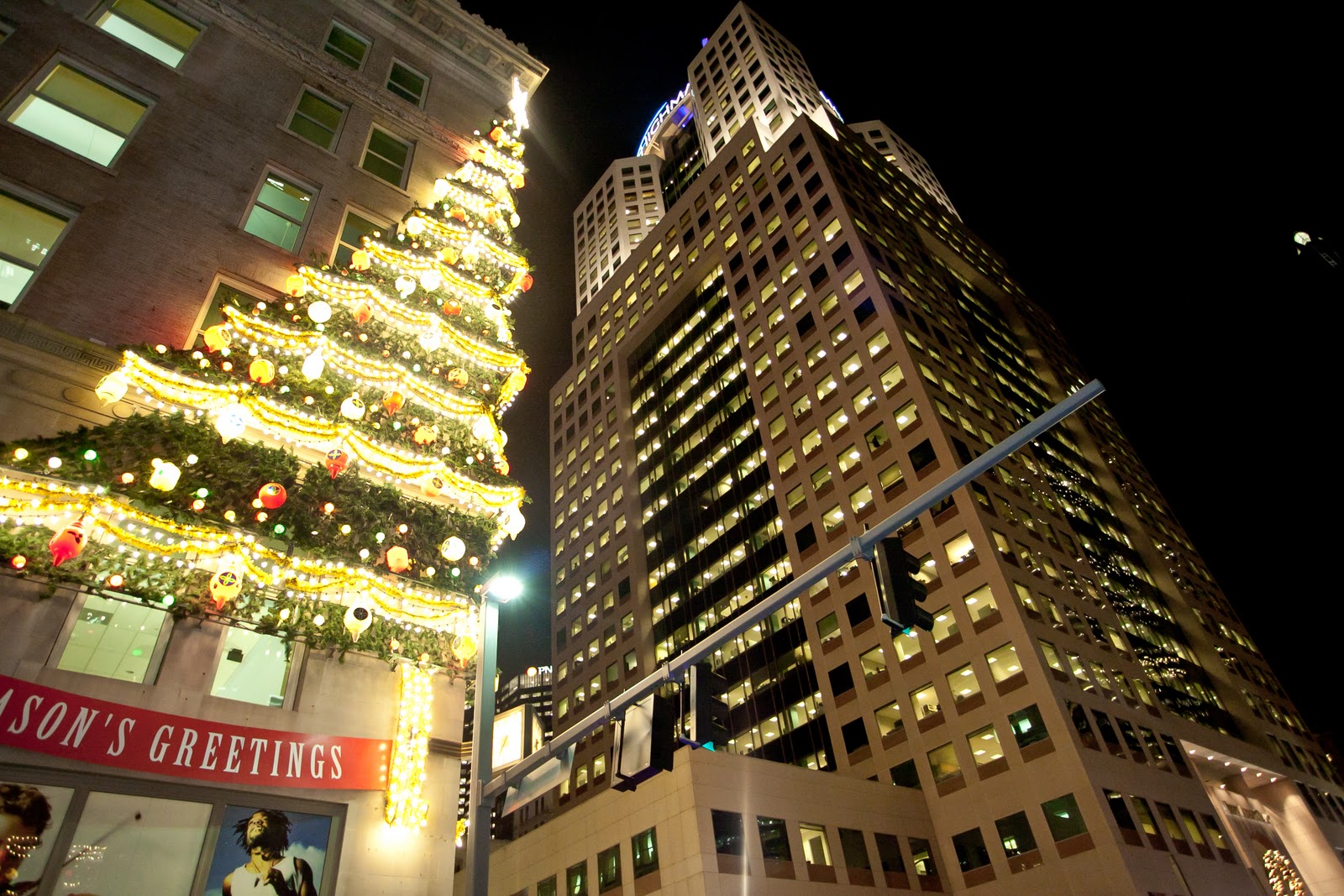
Each year, the biggest tree in town could be found at the corner of Penn and Stanwix clinging to the side of the Horne's store. Wrapped around the intersecting sides of the building, this towering conifer twinkled through the night all season long. Which sort of brings us back to the present because even though the names have changed, the tradition continues as the Unity Tree brightens Gateway Center and the "T" station from its perch on Highmark's Penn Avenue Place Building.

Somehow, we always manage to end up in the Square, where families are creating memories today for holidays of tomorrow, starting with Light Up Night(R) — a Pittsburgh tradition that crosses generations and even centuries — and continuing way past January 1 with the dazzling Eat 'n Park Season of Lights display that paints the Square with thousands of LED lights each evening.

It's never too late to start a Downtown holiday tradition — whether it's Light Up Night(R), the Season of Light, a spin around the skating rink, a ride on a horse-drawn carriage or special memory that's all your own. If you're looking for some ideas, see what these favorite Pittsburghers cherish about Downtown during this festive time of year, in the Holiday Memories section of our website.

7/08/2011

Halftime Report on the Square

Okay, just in case you're not keeping score at home, we wanted to let you know that Market Square is on track for a banner year. Just the other day we were checking the record books and discovered that in 2008 — the last full year before the Square's dramatic makeover — 34 events happened in the Square. Which was actually a pretty good total. But at the mid-point of 2011 — the first full year of the transformed Square — we tallied up 32 events so far with even more to come.

So, during this holiday-shortened working week, we've put together a photo album of some of 2011's high points in the Square. And if you look closely, you might even see yourself in a shot or two.

Even during the dead of winter, the Pittsburgh faithful turned out to show their pride during a high-five contest between Pittsburgh and Green Bay fans. While the Green Bay won the battle on the gridiron, we triumphed in the Square. 

We're always proud of our Scotch-Irish heritage in Pittsburgh — especially on St. Patrick's Day.  This year's greening of the Square included special family friendly activities. 

Always a popular lunchtime destination, the Square's menu got even better with the opening of three new eateries this year, including Winghart's Burger and Whiskey Bar.  By the way, Wingheart's is now open until 8:30 p.m. Wednesday-Friday and Saturday noon - 5 p.m.
For one of the meatiest sandwiches in town, the debut of DiBella's rocked the boat with choice cuts on freshly made bread. 

With the opening of NOLA, diners in the Square can enjoy the cuisine of New Orleans and a taste of Mardi Gras all year round.  

 
The Mayor and other dignitaries gave us a little history lesson as they unveiled a plaque recognizing the Market Square area's role in the Underground Railroad and Abolitionist Movement.


Springtime brings the return of the Farmers Market — a bounty of fresh. from-the-field foods and homemade treats from June through November.

There's something going on in the Square for everyone — including the wee ones. Kidsplay is a great way to introduce the young ones to the Square on Friday mornings in the summer from 10 - 11:30 a.m.

Our Thursday noontime concerts are a great way to relax and enjoy some of Pittsburgh's best musicians. Plus, you can tap your feet with live performances during the Market Square Merchant Association's Monday and Wednesday lunchtime shows and special Friday Happy Hour concerts.


For those seekking something more active on their lunch break, the YMCA has been hosting free outdoor exercise classes every Friday from noon - 1 p.m.


Let's be frank. We take our championships seriously in this town.  Which is why we relished hosting a regional contest to select a male and female winner to participate in the annual Fourth of July Nathan's Hot Dog Eating Championship on the famed boardwalk of Coney Island. Though our champs didn't earn the ultimate crown,
they devoured the local competition with a throng cheering them on. 

Whatever the reason, the Square is just a great place to relax with friends — anytime of the day. 

At the end of the day, Carin Mincemoyer's Diamond Diamonds art installation lights the way
to the heart of Downtown — Market Square. 

To learn more about any of these programs, restaurants or attractions, visit DowntownPittsburgh.com/Market-Square.

6/30/2011

Sparkle Plenty In The Square

Opening night in the Square and Diamond Diamonds scored rave reviews even before the morning papers hit the news stands. This dazzling new art installation, created by the talented Carin Mincemoyer, entranced passersby who strolled along Market Street, or as we like to call it, Pittsburgh's "Great Bright Way." On a perfect summer's eve, Diamond Diamonds lit up the skies with plenty of star power to fuel a long run in one of the city's hottest hot spots — Market Square. 

More than 15 months in the making, Diamond Diamonds was commissioned by the Pittsburgh Downtown Partnership and made possible through the work of the Office of Public Art and the City of Pittsburgh. Designed for daytime and nighttime enjoyment, it illuminates the Square's past as "the diamond" and serves as a guiding light to attract even more people to the Square and its many dining, shopping and recreational opportunities. 
But the real high-watt driving force behind Diamond Diamonds is Carin Mincemoyer. A CMU grad, the renowned artist led a team of welders, laser cutters and electricians to bring her stellar vision to light. The result is a brilliant scultpure in two parts, perched upon two city lamp posts on Market Street. Thus, her creation graces the street lights like a pair of Tiffany diamond earrings, Carin hopes that people will take a moment to look up. And what they'll see is a steel matrix of energy-saving LED lights twinkling inside 80 acrylic fixtures shaped like — what else? — diamonds. 

"I really want people to be surprised to see art hanging from the street lights when they're walking towards Market Square," Carin admits. "I picked the diamond theme to reflect on the Square's past and to play on the idea that a diamond is usually the focal point in a great piece of jewelry. I really hope that Diamond Diamonds will become a beacon that draws people from the Cultural District and other parts of Downtown to the Square." After teaming with Rick Frontera of Allegheny City Electric on a cloudy Tuesday morning to install Diamond Diamonds, Carin returned for the first night lighting with Rick, Renee Piechocki and Kate Hansen from the Office of Public Art, and Keny Marshall, artist, welder on the project and Carin's husband. 

As the power trio looked on, the turn of the century light fixtures flickered and then burned bright as Diamond Diamonds wowed onlookers, including Pittsburgh's own denizens and out-of-town visitors who stopped to snap a few photos for keepsakes. While Carin explained the theme behind Diamond Diamonds to admirers, Renee pointed out that "we really wanted to create something beautiful, thoughtful and interesting in this space. And to help people understand how it all ties in with the Square's history as Pittsburgh Diamond, we'll be installing be a plaque that details it all on each light pole."

Artist Talk and Reception
The Office of Public Art and Pittbsurgh Downtown Partnership invite you all to meet the artist in-person and view the sculptures.  On Thursday, July 14 the artist talk will take place on the 4th Floor of the Buhl Building, and the reception will take place in Market Street beneath the sculptures, block party style.  The event is free and open to the public but reservations are required.  For more info or to make your reservation, visit the Office of Public Art's webpage.

With Opening Night reviews in, Diamond Diamonds will be the sight to see when the lights go down in the city and the bright lights of Market Street switch on. 

For more background, see our previous blog posts on:
     The history of Market Square as "the diamond"
     Our first big post on the project
     Our first introduction of the project at the PDP Annual Meeting

Pittsburgh is full of great public art - check out this Pop City article.  In the "Oscar's of Public Art" Pittsburgh had three big wins.  Hear about these 2010 national winners and check out their nod to Carin's installation.  Kudos to the Office of Public Art, the artists and the many institutions that made these works possible!

Looking for the next big art project?  Point Park University and Riverlife have joined forces to improve the pedestrian access to the Mon Wharf via Wood Street. Wood Street - Mon Wharf Connection Project

6/17/2011

Diamonds in the Square

You don't really need a map to find your way to Market Square. But do you think you could locate the biggest Diamond in the City? Here's a clue... it's not in a jewelry store. Truth is, the "Diamond" is the historical name of the Square, which is why Forbes Avenue once was called Diamond Street. These days, we like to think that the Square is a glittering diamond that's at the heart of Downtown. So, let's take a look at how a once rough and tumble frontier spot transformed into a Diamond and then a rock solid stellar Square of a city showplace.

Now everyone knows that the British chased the French out of the region between the Allegheny and Monongahela rivers to establish the settlement in 1758. The Diamond officially took shape 20 years later when the Penn family surveyed the land nearby their manor home at Ft. Pitt at the Point. In a big time act of generosity, the Penns signed over to the city the deed to the land so that it could be put to good use as a social, civic and merchants' gathering spot. At its four corners, the Diamond pointed north, south, east and west and served as a compass for visitors who enjoyed the taverns and inns around the Diamond. Kind of sounds familiar, doesn't it?

While the British settled the area, the Diamond bears strong traces of our City's heavy Scotch-Irish heritage. Even today, one of the streets leading to the Square is called McMasters Way. And it turns out that Diamonds can still be found throughout the northern area of the Emerald Isle in places such as Rapahoe, Clones and a town called Donegal, which just happens to have a counterpart here in Western Pennsylvania. Donegal's Diamond is pictured above, used just as Pittsburgh's was before the court house and market was built. In Architectural Heritage of Western Pennsylvania, Charles Stotz writes, "Public squares or "Diamonds" were common in many early American towns, intended as 'practical provisions for the overnight parking of coaches, wagons, and horses rather than for beautification . . . [and as] social centers for towns.'"  And just across the Allegheny River, the land that sits in front of the former Buhl Science Center — now part of the wonderful Children's Museum — was a grassy expanse known as Diamond Park. Back then, it was the center of Allegheny City and just across the street from its very own Market House. Seems that Diamonds and Market Houses made good partners.


Well, very soon, diamonds will sparkle again in the Square thanks to artist Carin Mincemoyer, whose installation of 8-inch tall Plexiglas "diamonds" will accessorize lamp posts at the entrance of the Square. At night, LED lights will make the diamonds glitter and glow as people pass below to dine in the Square or just spend some time enjoying the summer winds and sounds of live music from NOLA and other hot spots. And, yes, we introduced you to Carin's creativity a few months ago, right here in this space. If you need a refresher course, just click here.

Okay, the lesson's over for today. And don't worry, there's no test — as long as you promise that we'll see you soon in the Square.


Special thanks for the historical information:
Pittsburgh History and Landmarks Foundation; Louise Sturgess, Al Tannler and Frank Stroker
Heinz Architectural Center at Carnegie Museum of Art; Raymund Ryan, Curator of Architecture

5/04/2011

Market Square — Then and Now

Just about every time we step into Market Square, it's like taking a time machine trip back to the earliest days of Pittsburgh. Maybe it's the Belgian block that paved the way for the city's first "modern" streets. Or maybe it's the fried-fish aroma wafting from the Square's oldest business Original Oyster House. And you could just say that it's the wide-open plaza of the "new" Square that hearkens to the original design of the space old-time Pittsburghers called "The Diamond" because its of its orientation to the four compass points. But the truth is, just about whatever direction you cast a glance, you're looking at a building linked to the city's past. And to show you what we mean, we put together a mini-photo album of "then and now" images of the Square not-so recent bygone days.

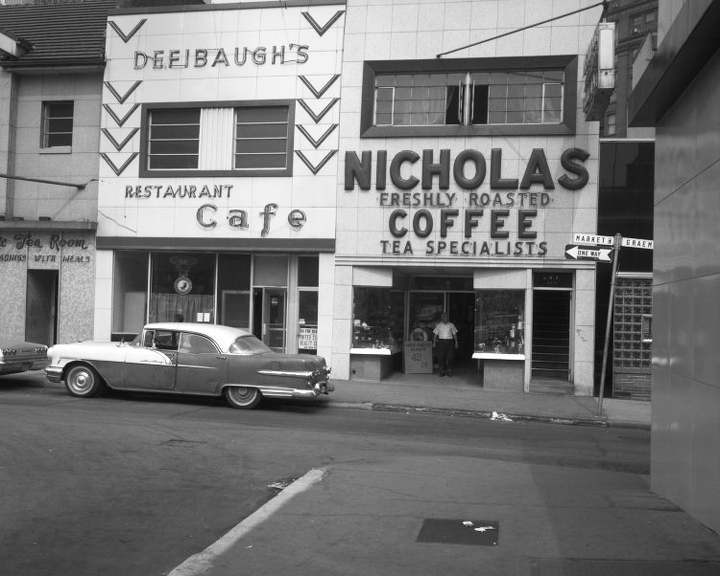
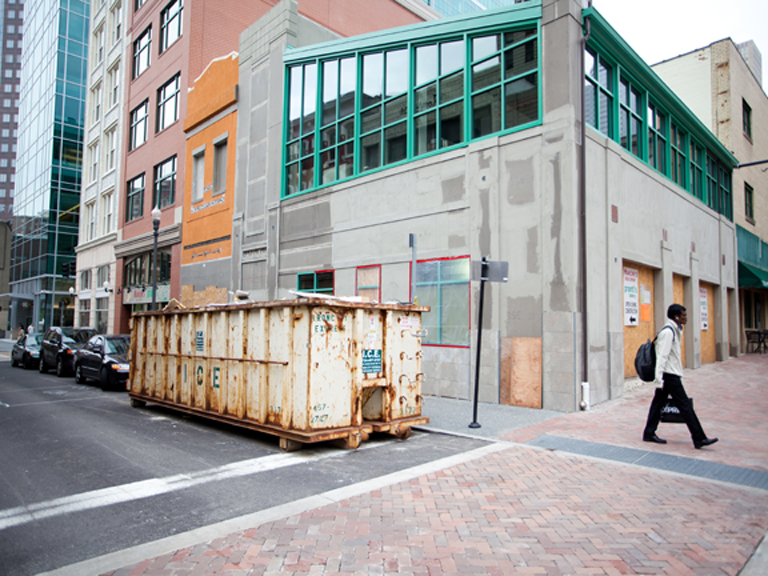
You don't have to be a historian to recognize the familiar name in the photo above. When that black-and-white shot was snapped nearly 50 years ago, Nicholas Coffee was freshly roasting the beans that helped perk up the morning for drowsy Downtown workers as they started another day at the office. Of course, a half-century can make a difference in any building's appearance. But if you check out the image to the right, we think you'll agree that the Square's favorite purveyor of coffee and tea looks pretty good with its Chippendale makeover in place of the building's 1940s decor.  And we're willing to bet that  Deifbaugh's Cafe served up some hearty old-time fare, but NOLA definitely adds some new spice to the Square with its bon temps roulet infused New Orleans style cuisine.


Now, if you execute a 180-degree spin, you'll be facing the corner of the-soon-to-be reopened Las Velas Mexican cantina and an under-construction new restaurant owned by the Primanti's proprietors. We love the all-glass facade of the upper floor of the building. And we have it on good word that the ground-level restaurant will provide an open-air atmosphere that will help bring the Square right into the dining area.  If you peer down Market toward Fifth Avenue, you can see the front of Prantl's and Mancini's new location, the freshly renovated blue and cream terra cotta Buhl Building and the luxe Fairmont Hotel. It's a diverse group, indeed.

But turn back the clock and that same stretch of street mixed up produce and poultry with jewelry and fancy footwear. Whether it was fresh fruit or a perfectly plucked chicken, this corner of commerce enjoyed a steady stream of potential customers looking for something to put on the dinner table. On the other hand, a different clientele might be looking to impress a certain special woman in his life with a sparkling bauble or two and maybe a new pair of shoes for himself. Coincidentally, the Nettleton Shop sits across the street today, selling some of the finest shoes around. Some things don't change all that much.


Our trip down memory lane takes a southern detour as we head to the spot where McMasters Way and Forbes Avenue meet. These days, if you look past Moe's Southwest, you'll spy Winghart's Burger and Whisky Bar, La Gondola pizzeria, Subway and Primanti's. But if you stood on that same corner in the early 1960s — a few years after the demolition of the market house that occupied what's now the Square's terrazzo plaza — the view would be a bit different, at least on the surface.

Back in 1962, a variety of business operated at street level of the Civil War era building that now houses Primanti's. Aside from a roof job and a new coat of paint, the former warehouse looks just about the same today. We can't say for sure, but we think the front of Bubble's Bar pretty much did double duty as the establishment's large-print menu for it's near-sighted patrons. And you don't have to be a surveyor to figure out that the Square's sidewalks had to be smaller back then. How else could you park cars on both sides of the street? And eagle-eyed readers will note that the upper right corner reveals a few structures that are long gone. But the PPG Place complex is welcome addition that will be around for a few years.

What makes for a truly amazing history walk is that so many of the buildings around the Square can trace their roots as far back as the 1860s. Which means that the past is always present when you're in Market Square.

4/14/2011

The Square Route to Freedom

These days, you don't need to rely on the North Star to chart a course to Market Square. But in the years before the Civil War erupted 150 years ago between the North and South, runaway slaves looked to the heavens above to find their way to the North on the Underground Railroad. Which is why Mayor Luke Ravenstahl led other dignitaries in the Square to unveil a commemorative plaque honoring Pittsburgh's proud past in helping African-American citizens escape bondage and live as free men and women.

Now, even though we're going to mix a little astronomy and history here for a moment or two, you don't need to worry since there's no test at the end. Still, we really want to invite everyone who visits the Square to take a moment or two to see the plaque — and the special LED Big and Little Dippers embedded in the center of the Square— to understand and appreciate the courage of African Americans seeking their freedom and the many brave Pittsburghers who helped them on their way.

Okay, if you want to spot the North Star, all you have to do is stand at the plaque and tilt your head back a bit and peer into the skies just over the roof of the Camera Repair Service building. Yes, it works a whole lot better if you try this after dark. Now, the North Star is always in the same spot in the sky (polar North) and the other stars in the constellations rotate around it through the night.  The lights in the ground are arranged as the stars would have been seen at 8pm on June 2, 1835. The sun is setting later and later now that spring has sprung, but you might catch a glimmer at 8pm.  The 8pm arrangement honors the first recorded meeting of the Pittsburgh Anti-Slavery Society.  Although there were plenty of abolitionist activites in the Burgh before that date this meeting was actually advertised in the newspaper as an organized and public meeting — more than a quarter of a century before the first cannon shot fired at Ft. Sumter in South Carolina set off the War Between The States.  Incidentally, this week marks the 150th anniversary of that first shot.  The rebels opened fire on Fort Sumter on April 12 at 4:30am.  Today, April 14, marks the day the first union soldier died.


Of course, we like to think we're near know-it-alls when it comes to the Square's storied past.  But we know when to make way for the professionals... Dr. Kimberly Ellis — she's the executive director of the Historic Hill Institute — mentioned that business owners and waiters in and around the Square often hid runaway slaves during their passage through the city. And did you know that in 1850 about 75 percent of the city's African American citizens lived beside white neighbors? Well, you can learn this and more on one of theHistoric Hill Institute's two Underground Railroad tours.

At a spry 97-years-old, Virginia O'Connor still can't get enough of the City she loves.  Collecting, recording and researching since her birth in 1914, it was Virginia who brought about the deeper investigation into Market Square's history with the Underground Railroad when she sent some unique documents to the renovation team - information that did not exist in record anywhere else.  You could say that Virginia O'Connor really did her homework when it comes to Pittsburgh's role in the Underground Railroad.  With a dedication and determination that would outshine people a quarter of her age, Virgina's commitment to the cause is truly a reason to celebrate.  Special thanks to the team of historians that verified and supplemented the information from Virginia, Dr. Laurence Glasco, John L. Ford (seen in the photo above), Dr. Kimberly Ellis (also in the above photo), and Terri Blanchette.

Along with honoring the city's strong role as a hot bed of abolition activity, the gathering also officially opened the al fresco dining and fun season in the Square. On hand to help the mayor usher in the festivities were PDP board chair Rich Beynon, Lloyd Wright of Sen. Ferlo's office, representatives from the Urban Redevelopment Authority, John Rohe of Colcom Foundation, Zach Winghart of Winghart's Burger and Whiskey Bar, developer Lucas Piatt, Bella Sera chef Jason Capps other Square business owners and regulars.

You read it here. History happens in Market Square. Make sure you're there when it does.

Special thanks to: Dr. Laurence Glasco, University of Pittsburgh, Department of History; John Ford, Historian and Curator of Artifacts and Documents; Dr. Kimberly Ellis, Historic Hill Institute, Executive Director; Terri Blanchette, Heinz History Center, Director of Community Programs; Bomani Howze, instrumental in assembling the team of researchers; Virginia O’Connor, a private citizen who began the investigation by sharing family history; Dina Klavon and Associates, designers; Hal Hilbish, lighting; Wilbur Smith and Associates, engineers; A. Merante Constracting, construciton adn installation.

The Market Square renovation is a project of Mayor Ravenstahl and the City of Pittsburgh. It is the culmination of several years of public process and has been made possible through the leadership, vision and financial contributions of the City of Pittsburgh, Heinz Endowments, Richard King Mellon Foundation, Colcom Foundation and Hillman Foundation.

PS  Other reasons this week is cool:

“The municipality of Washington, D.C., celebrates April 16 as Emancipation Day. On that day in 1862, President Abraham Lincoln signed the Compensated Emancipation Act for the release of certain persons held to service or labor in the District of Columbia.  The Act freed about 3,100 enslaved persons in the District of Columbia nine months before President Lincoln issued his famous Emancipation Proclamation. The District of Columbia Compensated Emancipation Act represents the only example of compensation by the federal government to former owners of emancipated slaves.

This is the reason tax day is not April 15 this year but was moved to April 18.  The IRS abides by D.C. holidays in addition to federal holidays.

6/22/2010

Thinking Outside The Square

Okay, everyone can find Market Square on a map of Downtown. After all, it's been Pittsburgh's favorite gathering place for more than 250 years. But we like to think of the Square as a state of mind that crosses streets and sidewalks beyond its boundaries to embrace its neighbors on Fifth and Forbes and Wood Street, too. That's why we're reminding you to discover what's outside the Square during a free Pittsburgh History & Landmarks Foundation tour of the Square and its surroundings this Friday at noon.

Hooking up with the tour is easy. The group meets in the grassy triangle of park in front of the fabulous new Fairmont Hotel. Just look for the guides holding up the yellow PHLF tour signs. Then around noon, you and your fellow intrepid hikers will take off to explore Downtown's past, present and future for the next 60 minutes.

Right off the bat, you'll learn why the beautiful blue and white Buhl Building — that's the one that looks like a really big piece of Wedgwood dinnerware —  on the corner of Market and Fifth has the name "Bash" above its entry. And if you turn your eyes to the skies, you'll see all 23 stories of the shiny new Three PNC Plaza, the home of the Fairmont and the greenest mixed-use building in all of the United States. And that's just the start.

A few steps along Fifth, you'll take in the lovingly restored facades of once neglected buildings from the late 19th and early 20th centuries that are now bustling with new businesses and living spaces like the stylish MarketSquare Place Lofts.

Now if your appetite needs to be satisfied, you can visit the hot dog vendor across from the Capitol Grille on Wood and Fifth as the group admires the giant living mural growing on the side of the main PNC building. After a short stop on Wood Street to inspect a wonderful terra cotta building and the only remaining wooden front structure Downtown, the trek will move on to the intersection of Wood and Market. There, the guides will direct your attention to one of the city's oldest establishments — Weldin's Stationery Store — and one of the newest, the chic Boutique la Passerelle. While you're on the corner, try to spot one of the skinniest buildings you'll ever see anywhere.

Pardon the construction on Forbes Avenue as workers busily pour concrete for a new road lead to the Square. Once you pass the almost venerable George Aiken's restaurant, you'll make tracks to Pittsburgh's longest-running eatery — the world-famous Original Oyster House. Now, we certainly will understand if you can't resist the temptation to take a step back in time to savor one of the best fish sandwiches around. But we really do recommend that you stick with the tour to the end. If you do, you'll catch a peek of the relocated Mancini's and Prantl's shop on Market, just across the street from the Nettleton Shoe Shop and Heinz Healy's mens clothing store.

You'll end the tour across the street from where you started at the one of Downtown's most-traveled and least-known byways — Graeme Street. Only about 100 feet long, Graeme cuts alongside the Diamond Building on Fifth and Liberty before ending in the Square. It's also the address of one of the most intimate housing spaces Downtown, the Residences at Market at Fifth with only 7 units.

Now for extra credit, pay attention to  your tour guide this Friday. Because we'll be checking back to see who knows why Market Square was once better known as the Diamond.

The Pittsburgh History & Landmarks Foundation walking tours of the Market Square area end this Friday. So circle the date now.

4/22/2010

Belgian Block

Ever wonder why we make such a big deal about the stones in the roadway? 


There is history in these blocks.  Chris Potter, editor of Pittsburgh City Paper, wrote a great article on Pittsburgh's early road materials in 2004. We started with wooden blocks, then cobblestone, then belgian block.  Cobblestones are just any old rocks and were often round or irregluar in shape.  Belgian block is made of granite cut into a regular rectangular shape.

Belgian Block became a popular road material in the late 1800s.  It was the most expensive option available but it was the most durable and offered the smoothest, quietest ride available at the time.  In many places thoughout the City, if the pothole is big enough, you can see clear down to the original paving - block stone! The new design for Market Square requires a lot of belgian block... more than we had.  Fortunately, there is belgian block all over the City.  That's how we got the rest of the belgian block needed for Market Square.  While they were working on the Rivers Casino project they uncovered a bunch of belgian block that could be reused in this City project.  So now that piece of Pittsburgh history gets to see the light of day again in Market Square.


Pittsburgh is very good at maintaining a deep connection to its history and at the same time being a center of innovation. It's not just the architecture that makes people speak of Pittsburgh as more of a European City, it's that cultural connection we have to past, present and future. And its one of the things transplants like me really love about this city.  As the center of Downtown, Market Square really represents that - a connection to its past while it greets new businesses and residents, a place you can sit and enjoy historic buildings and skyscrapers at the same time.  Our sneakers and tires roll across the blocks that once clattered with fancy laced boots and horse hooves, and although we still eat oysters in the Square instead of reading penny newspapers we can watch the news on the TV at the bar, read the online paper with the Downtown WiFi, or pull out our smart phones!  That's pretty exciting!

2/05/2010

The March of Time

The PDP is working with some Pittsburgh historians to delve into the history in and around Market Square.  Yesterday they reported their preliminary findings and it was so exciting!

The Square (then called "the Diamond") was already in place in 1784.  You can see it here (the big open spot in the middle) in the original plan for the City laid out by George Woods and Thomas Vickroy, surveyors from Philadelphia.


226 years ago.

Market Square existed before the American Constitution! (The Constitution we have today was not created until 1787 at the Constitutional Convention held in Philadelphia.  Yeah, that's right, PA was a high roller.)

Market Square started out as an open area.  Then the space was filled with the City's first court house and a semi-circular market structure with open stalls on both sides.  Eventually they turned it into two Market Houses.  After suffering fires in each building, the Market Houses were rebuilt on an even larger scale.  These are the buildings some Pittsburghers may remember or have seen in photographs (Forbes Avenue runs as a tunnel beneath both buildings and there is a pedestrian bridge over Market Street - a good picture in our Galardi's Dry Cleaning posting in December).

Most people think of old Market Square as the buildings in the center but there was a huge amount of transition and activity in the properties all around them, too.  Set out in 1784 as the square for the City, it was, from its very beginning, a place for everyone in Pittsburgh to mix, mingle, and conduct business and social life - the melting pot for the entire City.  There were businesses owned by blacks, Irish, Germans, Italians... A hotel, a beer and soda distributor, a butcher, oyster bars that evolved into ice cream shops and lunch counters as America's tastes changed... At one point people came to Market Square for activities as diverse as buying freshly made pasta, drinking at one of the pubs, watching a prize fight, or attending a classical concert!

I am holding off on pictures here but rest assured, you will see many in the future! 

We see the Square evolving right in front of our eyes today.  But this is just one day, in one year, out of two hundred and twenty-six.  The Square will be here long after we are gone and future generations will think the photos we take today are a charming look at a time gone by.  When we share photos of the past in this blog, think about this... one day we will be the people in those pictures.  When they were here, their lives were vital, they were contemporary, they were entrepreneurs in the heart of Downtown, they were taking charge of their own lives, just as we do today.  All things change.  With the rennovation of the center of the Square and the many buildings ajacent, today is going to be one of the points in history people look back to as significant.  We remember the dates the last Market Houses were built, we look at the date the Market Houses came down, the date PPG Place was built... these are the touchstones historians and communal memory treasure. One day, history will place 2009-2011 in that category and we were here to see it and live it.

Change is hard.  But Market Square's entire story is about change.  It has existed and evolved since the very beginning of our City, and America's youth as a country.  We are part of that today.  That's pretty spectacular.

Special recognition to: Laurence Glasco, Carmen DiCiccio, John Ford, and Pittsburgh History and Landmarks Foundation for any historical content referenced in this post.  They are doing great work and I look forward to sharing more of it with you.